Dog diarrhoea: what to feed your dog and when to worry
Almost every dog gets it sooner or later, usually because of something it ate. Most cases clear up in a few days with water and light meals. Here is what to feed, how much, what to avoid and which signs mean it's time to see the vet.
In short
With diarrhoea, water comes first: your dog must be able to drink at all times. There is no need to withhold food for a day or two, as used to be advised: the most recent veterinary nutrition textbooks recommend starting again early with small, highly digestible meals, such as well-cooked white rice and boiled chicken breast. Start with very little, increase as the stools improve and go back to the usual food over 3-4 days. A puppy, blood, repeated vomiting, a dull dog or diarrhoea lasting more than two days: see the vet straight away.
Once your dog is well again: build the plan with Chicken →
What should I feed a dog with diarrhoea?
Small, frequent meals of a highly digestible, low-fat food, with water always available. The most common home option is a “bland diet”: well-cooked white rice with a lean meat.
| Recipe | Proportions | When to choose it |
|---|---|---|
| Chicken and rice | 1 part boiled chicken breast, skin and visible fat removed, to 4 parts well-cooked white rice | The usual choice |
| Cottage cheese and rice | 1 part low-fat cottage cheese to 1 part well-cooked white rice | If your dog already eats chicken every day |
No salt, oil, butter or seasoning. White rice is lean, low in fibre and usually well liked; skinless chicken gives protein with little fat. These are the two short-term recipes given in the textbook Applied Veterinary Clinical Nutrition (2023).
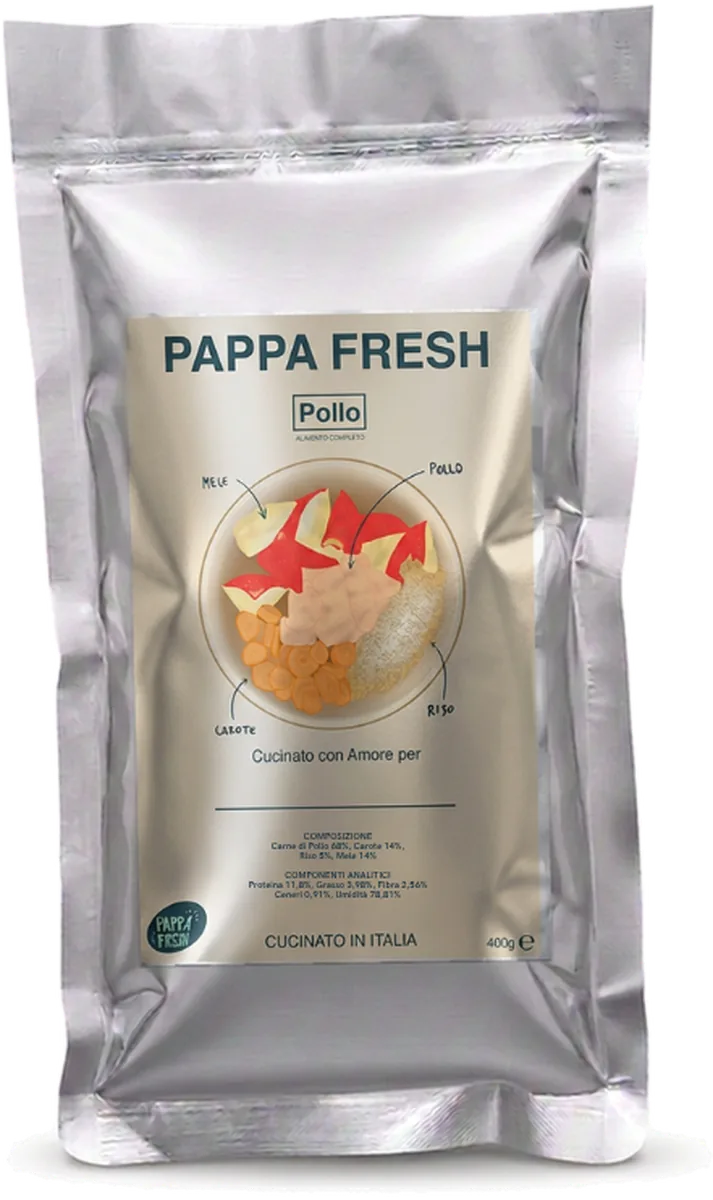
Remember: a bland diet is not a complete diet. It is fine for a few days, not for weeks. Once your dog is well again, you can move on to our Chicken recipe: chicken and rice, with chicken heart, carrots and apple, ready to serve and complete.
Once your dog is well again
Our Chicken recipe, ready to serve
Chicken and chicken heart, rice, carrots and apple, with a vitamin and mineral supplement: a complete food, steam-cooked and sterilised in its pouch. No freezer needed: unopened pouches keep in the cupboard.
Should a dog with diarrhoea be starved?
No, not for days. For years owners were told to withhold food for 24-48 hours. The most recent clinical nutrition textbooks point out that this advice was never based on studies and that, in experiments, even a short fast weakens the gut barrier instead of resting it.
Today the advice is to keep your dog drinking and to start again early with small amounts of food. In a study of puppies hospitalised with parvovirus, those fed from 12 hours after admission improved sooner and regained weight faster than those kept without food until they stopped vomiting (Mohr et al. 2003).
If your dog is vomiting, let the stomach rest for a few hours, then try again with a very small amount. If the vomiting continues, call the vet.
How much and how often should I feed a dog with diarrhoea?
Little and often: on the first day, about a sixth of what your dog usually eats, split into 3-4 meals. Small meals put less strain on the stomach and gut.
- Day 1: small portions of the bland diet, 3-4 times a day.
- Days 2-3: if the stools improve and there is no vomiting, increase a little each day.
- From day 3-4: once the stools are formed again, go back to the usual food by mixing it into the bland diet over 3-4 days: first a quarter, then half, then three quarters.
If the diarrhoea comes back when you return to the normal food, take a step back and talk to your vet.
What should you not give a dog with diarrhoea?
Anything fatty, new or hard to digest. While the diarrhoea lasts, avoid:
- fat and rich food: leftovers, cold meats, mature cheese, chicken skin, treats;
- milk: after a bout of gastroenteritis the gut can struggle to digest lactose for a while;
- bones and hard chews;
- foods your dog has never eaten before, and switching kibble or wet food during those days;
- lots of fibre all at once, which can make wind and tummy pain worse;
- human medicines without your vet's advice: some are dangerous for dogs, and breeds such as collies and Australian shepherds are very sensitive to loperamide, a common anti-diarrhoea drug.
How can you tell small-bowel from large-bowel diarrhoea?
By how the stools look and how often your dog goes. It is not a diagnosis, but it helps you explain to the vet what is happening.
| Small bowel | Large bowel (colon) | |
|---|---|---|
| How often | A few times a day, large amounts | Many times, a little each time |
| Appearance | Watery and abundant | With mucus, sometimes with fresh red blood |
| Urgency and straining | Rare | Common |
| Vomiting | More common | Rare |
| Weight | May lose weight if it lasts | Usually no weight loss |
In large-bowel diarrhoea, with mucus and straining, a little extra fibre (psyllium, for example) often helps: ask your vet how much to give.
Do probiotics help a dog with diarrhoea?
They may help a little, but they are not essential. In a controlled study of dogs with acute gastroenteritis, those given a probiotic stopped having diarrhoea slightly sooner than those given a placebo (Herstad et al. 2010), but later reviews still rate the evidence as weak.
If you want to try one, choose a product made for dogs and ask your vet. Yoghurt is not the same thing: it is not a probiotic studied in dogs and it contains lactose, which can make things worse during these days.
When should I take my dog to the vet for diarrhoea?
Straight away if even one of these signs is present:
- it is a puppy, an older dog or a dog with an existing illness;
- it vomits several times or cannot keep water down;
- there is blood in the stools, fresh red or black like tar, or in the vomit;
- it is dull, has a swollen or painful belly, or a fever;
- it may have eaten something toxic or swallowed an object;
- it is not drinking, or its gums are dry or sticky;
- the diarrhoea lasts more than two days, or keeps coming back.
It is usually not serious: in the VetCompass study of the records of over two million dogs in the UK, about 8% of dogs were seen by a vet for acute diarrhoea in a year and more than 80% of cases needed only one visit. But dehydration sets in quickly, especially in small dogs: read how to recognise and prevent dehydration.
Are some breeds more prone to tummy trouble?
Yes: some breeds get acute diarrhoea or long-term gut problems more often.
- Maltese and Miniature Poodle: in the VetCompass data they were about twice as likely to have acute diarrhoea as crossbreeds.
- German Shepherd: the classic breed for exocrine pancreatic insufficiency, with large stools and weight loss.
- Yorkshire Terrier: among the breeds most affected by a rare disease in which the gut loses protein.
- Boxer and French Bulldog: can develop a chronic colitis with mucus and blood while still young.
If your dog belongs to one of these breeds and the diarrhoea keeps coming back, don't stop at the bland diet: it needs a diagnosis.
Where Pappa Fresh fits in
To be clear: while the diarrhoea lasts, follow the advice above and your vet's. Pappa Fresh is not a veterinary diet for digestive disorders.
Once your dog is well again, our recipes are made for everyday feeding and designed to be easy to digest: real meat as the first ingredient (52% to 67%), one animal protein per recipe and ingredients you can recognise on the label. Our Chicken recipe, for example, is chicken, chicken heart, carrots, apple and rice, steam-cooked and sterilised in its pouch.
If your dog already eats Pappa Fresh, go back to its recipe with the gradual steps above. If you'd like to try it, wait until your dog is well and switch over 7-10 days.
Two minutes, portions calculated for your dog, 30% off your first order.
Frequently asked questions
How much chicken and rice should I give a dog with diarrhoea?
Very little at first: about a sixth of the usual amount, split into 3-4 meals, with 1 part chicken to 4 parts rice. If the stools improve, increase every day; within 3-4 days go back to the normal amount and then to the usual food.
Can I give milk or yoghurt to a dog with diarrhoea?
Better not. After gastroenteritis the gut can struggle to digest lactose for a while, and milk can make the diarrhoea worse. If you want to try a probiotic, ask your vet for one made for dogs.
How long does diarrhoea last in dogs?
Mild cases usually improve within 1-3 days. If it lasts more than two days, keeps coming back, or comes with blood, vomiting or a dull dog, take your dog to the vet.
Should a dog with diarrhoea drink water?
Yes, always. Water is the most important thing: with diarrhoea a dog loses fluids and salts and can become dehydrated quickly, especially if it is small or a puppy. If it won't drink or vomits the water, call the vet.
Can I give my dog a human anti-diarrhoea medicine?
No, not without your vet. Some human medicines are dangerous for dogs, and breeds such as collies and Australian shepherds are very sensitive to loperamide.
Sources
- Fascetti, Delaney, Larsen, Villaverde (eds), Applied Veterinary Clinical Nutrition, 2nd ed. (2023) — ch. 11, gastrointestinal diseases
- Hand et al., Small Animal Clinical Nutrition, 5th ed. (2010) — ch. 56 and 62, acute gastroenteritis and colitis
- Mohr et al. 2003, Journal of Veterinary Internal Medicine — early enteral nutrition in puppies with parvoviral enteritis
- Herstad et al. 2010, Journal of Small Animal Practice — a probiotic in acute canine gastroenteritis
- Veterinary Evidence — metronidazole or probiotics for acute gastroenteritis in dogs? An evidence review
- O'Neill et al. 2025, PLOS ONE — acute diarrhoea in dogs under primary veterinary care in the UK (VetCompass 2019)
Pappa Fresh editorial team
Written by the Pappa Fresh editorial team from published veterinary studies (see sources). Not a substitute for your vet's advice.
Read next:
- Dog bad breath: where it comes from and what to do
- Dog gas and flatulence: why it happens and what to do
- Shiny dog coat: what really matters in the diet
- Foods dogs can't eat: what's toxic and what to do
- Dog won't eat dry food: why it happens and what to do
- Feeding an older dog: what changes and what to give
- Bloat in dogs (GDV): signs, risks and what to do
- Constipation in dogs: what to give and when to worry
- How to prevent dehydration in dogs