Foods dogs can't eat: what's toxic and what to do
Some foods we eat every day are dangerous for dogs, sometimes even in small amounts. Here is which ones, how much is too much, what your dog can eat safely and what to do if it has already eaten something it shouldn't.
In short
The most dangerous are chocolate and cocoa, grapes and raisins, onion and garlic (cooked or powdered too), the xylitol in sugar-free gum, macadamia nuts, raw yeast dough, alcohol and cooked bones. For many of them what matters is the dose per kilo of body weight, so small dogs are most at risk; for grapes, though, there is no known safe amount. If your dog has eaten any of them, call the vet straight away, without waiting for symptoms and without trying to make it vomit yourself.
None of this in our recipes: see the Trial Box →
Which foods are toxic to dogs?
These are the most dangerous everyday foods for dogs:
| Food | Why it is harmful | What can happen |
|---|---|---|
| Chocolate and cocoa | Theobromine and caffeine, which dogs clear very slowly | Vomiting, restlessness, racing heart, tremors, seizures |
| Coffee, tea, energy drinks | Caffeine | The same effects as chocolate |
| Grapes, raisins, sultanas, tamarind | Tartaric acid is the suspected cause | Kidney damage, even from a few grapes |
| Onion, garlic, leek, shallot, chives | They damage red blood cells, cooked or powdered too | Anaemia, which only shows after a few days |
| Xylitol (E967): sugar-free gum, sweets and bakes | Makes blood sugar crash | Weakness, seizures, liver damage |
| Macadamia nuts | The cause is not yet known | Weakness, tremors, high temperature |
| Alcohol and raw yeast dough | The dough rises in the stomach and produces alcohol | Swollen belly, wobbliness, even coma |
| Cooked bones, corn cobs, fruit stones | They splinter or get stuck | Wounds in the mouth and gut, blockages |
| Very fatty leftovers: crackling, fried food, meat fat | Too much fat at once | Vomiting, diarrhoea, sometimes pancreatitis |
| Very salty food and homemade salt dough | Too much salt | Thirst, vomiting, tremors in severe cases |
| Mouldy food and compost | Toxins made by moulds | Tremors and seizures |
For chocolate, onion, xylitol and macadamia nuts the risk depends on how much your dog eats compared with its weight: an amount that does nothing to a Labrador can make a Chihuahua ill. For grapes, there is no known safe dose.
How much chocolate is dangerous for a dog?
It depends on the type of chocolate and on your dog's weight: the darker it is, the less it takes. Chocolate contains theobromine and caffeine, which dogs clear much more slowly than we do: it takes them about 17 and a half hours to get rid of half the theobromine.
According to the Merck Veterinary Manual, the first signs (vomiting, diarrhoea, drinking a lot) can appear at 20 mg of these substances per kg of body weight; from 40-50 mg/kg the heart is affected and from 60 mg/kg seizures are possible. This is how many grams it takes to reach the first 20 mg/kg, by your dog's weight (mg/g = milligrams of theobromine and caffeine per gram):
| Type | mg/g | 5 kg | 10 kg | 30 kg |
|---|---|---|---|---|
| Cocoa powder | 28.5 | 3.5 g | 7 g | 21 g |
| 100% cocoa chocolate | 15.5 | 6.5 g | 13 g | 39 g |
| Standard dark chocolate | 5.3-5.6 | 18 g | 36 g | 110 g |
| Milk chocolate | 2.3 | 43 g | 87 g | 260 g |
A 70-85% dark chocolate sits between standard dark and 100%. White chocolate contains almost no theobromine, but it is fatty and sugary: best avoided too.
Signs usually appear after 6-12 hours and in severe cases last up to 3 days. If your dog has eaten chocolate, call the vet straight away: within a couple of hours they can still make it vomit.
Why are grapes and raisins so dangerous for dogs?
Because they can seriously damage the kidneys, and there is no way of predicting which dog will be affected. Some dogs eat grapes with no ill effects, others fall ill after a few. The suspected cause today is tartaric acid, which is highly concentrated in grapes and tamarind: in 2022 a group of American vets described dogs with kidney damage after eating cream of tartar or tamarind, both rich in it, and dogs seem to clear it poorly.
Dogs usually vomit or have diarrhoea within 6-12 hours; in severe cases the kidneys stop producing urine within 1-3 days, and at that point most dogs do not survive. That is why even a single grape is a reason to call the vet: the Merck Veterinary Manual already considers more than one grape or raisin per 4.5 kg of body weight a risk.
Raisins and sultanas hidden in fruit cake, mince pies, hot cross buns and breakfast cereals count too.
Are onion and garlic bad for dogs even when cooked?
Yes: raw, cooked, dried or powdered, they damage red blood cells just the same. The result is anaemia that appears a few days later, usually 3-5, when nobody remembers that dinner any more: the dog is weak, has pale or yellowish gums, breathes fast and sometimes passes red or dark urine.
In dogs, as little as 5-10 g of onion per kg of body weight has caused moderate anaemia: for a 10 kg dog that is 50-100 g, between half and one medium onion. Garlic is 3 to 5 times more toxic than onion. Leeks, shallots and chives belong to the same family.
Watch out for hidden sources: gravy, stock and stock cubes, sausages and cold meats, pizza, ready meals and baby food often contain onion or garlic powder, which is concentrated. For the same reason, garlic as a "natural flea remedy" is not a good idea.
Why is xylitol dangerous for dogs?
Because in dogs it makes blood sugar crash quickly and, at higher doses, damages the liver. Xylitol is a sweetener (also listed as E967) found in sugar-free chewing gum and sweets, mints, some peanut butters, "sugar-free" bakes, toothpaste for people, chewable vitamins and syrups.
According to the Merck Veterinary Manual, more than 0.1 g per kg of body weight can cause hypoglycaemia, sometimes within 30 minutes (with gum, as late as 12-18 hours); more than 0.5 g per kg can cause liver damage that shows after 1-2 days. In one study, more than six in ten dogs with signs of liver damage died despite treatment.
For a 5 kg dog, 0.5 g is enough for hypoglycaemia: check labels and keep gum, handbags and coats out of reach. If you use peanut butter as a reward, choose one without xylitol.
Can dogs eat bones?
Cooked bones, never: they splinter into sharp fragments. They can injure the mouth and throat, get stuck in the oesophagus or stomach, puncture the gut or form a hard plug that causes constipation. Raw bones are not risk-free either: they can break teeth and get stuck.
In a Swiss study of 102 dogs that had a foreign body removed from the oesophagus or stomach by endoscopy, bones and a body weight under 10 kg were among the factors linked to more complications (Gianella et al. 2009).
The same goes for corn cobs and peach, apricot or avocado stones, which easily get stuck. If your dog needs to chew, give it a toy or a chew made for dogs, under your supervision.
Which human foods can dogs eat?
Plenty of simple foods, cooked and unseasoned, in small amounts.
- Meat and fish: chicken, turkey, beef, well-cooked pork, cooked fish without bones; no skin, bones or seasoning.
- Eggs: cooked.
- Carbohydrates: cooked rice, pasta and potatoes, with no salt and no sauce.
- Vegetables: carrots, courgettes, green beans, pumpkin, cucumber.
- Fruit: apple and pear without core or seeds, blueberries, seedless watermelon, a few slices of banana.
- Dairy: a small piece of low-fat cheese or a spoonful of plain yoghurt, if your dog digests them well.
A practical rule: extras should stay under 10% of the day's calories, as veterinary nutrition textbooks advise. Beyond that you risk unbalancing your dog's diet and making it put on weight.
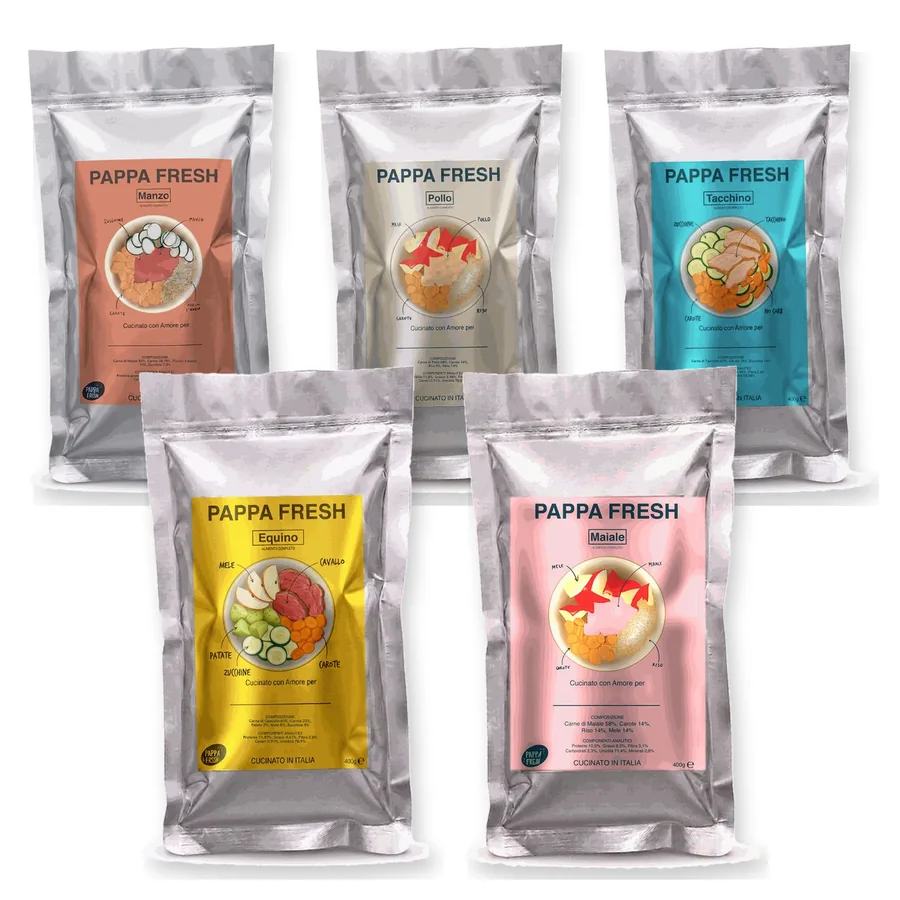
The simplest way to get it right is to feed a complete food made with ingredients you recognise, every day. Our 5 recipes are made of meat, vegetables, fruit, rice or oats and a vitamin and mineral supplement: none of the foods in the list above.
None of this in our recipes
Try all 5 recipes with the Trial Box
One 400 g pouch of each recipe: beef, chicken, turkey, horse and pork. Real meat as the first ingredient, vegetables, and no onion, garlic, grapes or bones. No preservatives, no subscription.
What should I do if my dog ate something toxic?
Call your vet or an out-of-hours emergency vet straight away, even if your dog seems fine. With chocolate, grapes, onion and xylitol, signs can take hours or days to appear, when it is too late to make the dog vomit.
- Gather the facts: what it ate, how much, when, and how much your dog weighs. Keep the packaging: with chocolate and xylitol the label matters.
- Don't make it vomit yourself. Salt water, an old remedy, can cause salt poisoning, and vomiting is not safe if the dog is drowsy or has swallowed something sharp. If needed, your vet will do it with the right medicines, usually within a couple of hours.
- Don't wait for symptoms and don't give home remedies such as milk or oil.
- Go straight away if your dog vomits repeatedly, trembles, has seizures, is very weak, has a swollen belly, pale or yellowish gums, or dark urine.
Which dogs are most at risk?
Small dogs, because the dose counts per kilo of body weight, and the greediest dogs, because they find the food before you do.
- Small and toy breeds such as the Chihuahua, Yorkshire Terrier, Maltese, Pomeranian and Miniature Pinscher: for a 2 kg dog, 7 g of dark chocolate is enough for the first signs.
- West Highland White Terrier and Yorkshire Terrier: in the Swiss foreign-body study they were more common than among the hospital's other patients.
- Labrador: about one in four carries a variant of the POMC gene linked to greater hunger and food motivation (Raffan et al. 2016). Food left on the table or in the bin is an invitation.
- Puppies: they explore everything with their mouth and weigh little.
With these dogs, keep chocolate, raisins, gum and leftovers shut away up high, and tell children and guests too.
Where Pappa Fresh fits in
Our recipes contain none of the foods on this page: no onion, garlic, grapes, chocolate, xylitol or bones. Each recipe is a complete food, with a single animal protein and ingredients you can read on the label:
- Beef: beef, carrots, oat flakes, zucchini;
- Chicken: chicken, carrots, apple, chicken heart, rice;
- Turkey: turkey, zucchini, carrots;
- Horse: horse meat, carrots, potatoes, apple, zucchini;
- Pork: pork, carrots, rice, apple;
plus a vitamin and mineral supplement. They are steam-cooked and sterilised in the pouch, with no preservatives, and we calculate the portions for your dog: that way extras really stay extra.
5 pouches of 400 g, one of each recipe, no subscription.
Frequently asked questions
My dog ate a grape: what should I do?
Call your vet straight away, even if your dog seems fine. With grapes there is no known safe dose and kidney damage can appear after 1-3 days. If you get there within a couple of hours, the vet can make your dog vomit.
Can dogs eat bananas?
Yes, a few slices now and then. Bananas are high in sugar, so don't overdo it.
Can dogs eat cheese?
A small piece now and then, yes, if your dog digests it well. Choose low-fat, low-salt cheese: many adult dogs digest lactose poorly and fatty cheese can cause vomiting or diarrhoea.
Can dogs eat bread and pasta?
Yes, plain and cooked, in small amounts. Never raw yeast dough: it rises in the stomach and produces alcohol.
Can dogs eat eggs?
Yes, cooked. Better not raw: they can carry salmonella and raw egg white reduces the absorption of biotin, a vitamin.
Can dogs drink milk?
Better not: many adult dogs digest lactose poorly and milk can cause diarrhoea.
Sources
- Merck Veterinary Manual — Chocolate Toxicosis in Animals (theobromine and caffeine by type of chocolate, doses and timing)
- Merck Veterinary Manual — Grape, Raisin and Tamarind Toxicosis in Dogs
- Merck Veterinary Manual — Allium spp Toxicosis in Animals (onion and garlic)
- Merck Veterinary Manual — Xylitol Toxicosis in Dogs
- Merck Veterinary Manual — Macadamia Nut Toxicosis in Dogs
- Merck Veterinary Manual — Bread Dough Toxicosis in Animals
- Wegenast et al. 2022, Journal of Veterinary Emergency and Critical Care — cream of tartar, tamarind and tartaric acid
- Gianella, Pfammatter, Burgener 2009, Journal of Small Animal Practice — oesophageal and gastric foreign bodies in 102 dogs
- Raffan et al. 2016, Cell Metabolism — a POMC gene variant, appetite and weight in Labradors
- Hand et al., Small Animal Clinical Nutrition, 5th ed. (2010) — ch. 11, food safety (onion, garlic, chocolate)
- Fascetti, Delaney, Larsen, Villaverde (eds), Applied Veterinary Clinical Nutrition, 2nd ed. (2023) — ch. 7 (extras within 10% of calories) and ch. 12 (table scraps and pancreatitis)
- ASPCA — People Foods to Avoid Feeding Your Pets
- Pet Poison Helpline — Salt (why salt water must not be used to induce vomiting)
Pappa Fresh editorial team
Written by the Pappa Fresh editorial team from published veterinary studies (see sources). Not a substitute for your vet's advice.
Read next:
- Dog bad breath: where it comes from and what to do
- Dog gas and flatulence: why it happens and what to do
- Shiny dog coat: what really matters in the diet
- Dog diarrhoea: what to feed your dog and when to worry
- Dog won't eat dry food: why it happens and what to do
- Feeding an older dog: what changes and what to give
- Bloat in dogs (GDV): signs, risks and what to do
- Constipation in dogs: what to give and when to worry
- Can You Give Dogs Table Scraps?