Bloat in dogs (GDV): signs, risks and what to do
It is one of the most serious emergencies for a large dog: the stomach swells and twists, and without fast treatment the dog can die within hours. Here is how to recognise it, what to do straight away, which dogs are most at risk and which habits really matter.
In short
Bloat, or gastric dilatation-volvulus (GDV), mostly affects large and giant dogs with a deep chest: in one study, between 21% and 24% of these dogs had it during their lifetime. The typical signs are a swollen belly, retching without bringing anything up, drooling and restlessness: it is an emergency, go to the vet straight away, even at night. To lower the risk, habits matter: two or three meals a day instead of one, eating calmly, no running straight after, no raised bowl. In very high-risk dogs the vet may suggest a gastropexy, which fixes the stomach in place.
For large dogs: build the plan with Beef →
What is bloat in dogs?
The stomach fills with gas, food and fluid, swells and twists on itself. As it twists it closes off the way in and the way out, so the gas cannot escape, and it chokes the blood vessels of the stomach and spleen. The dog goes into shock quickly.
Vets call it gastric dilatation-volvulus. There is also dilatation alone, without twisting, more common in young dogs that have overeaten: from the outside the two look alike, and only the vet can tell them apart with an X-ray. In both cases, you don't wait.
What are the signs of bloat in dogs?
A swelling belly and retching without bringing anything up are the signs never to ignore. The most typical signs:
- restlessness: the dog can't settle, gets up and lies down again;
- a belly that swells and becomes tight, like a drum;
- repeated retching without vomiting, or only a little froth;
- a lot of drooling;
- belly pain, heavy breathing;
- then pale gums, weakness, collapse.
It often happens at night or early in the morning, sometimes after a big meal, and owners often remember a stressful event in the days before, such as kennels, travel or a show.
What should I do if I suspect bloat?
Go straight to an open vet clinic, even at night, and call on the way. Every minute counts.
- Don't give food or water.
- Don't try home remedies and don't wait for it to "pass".
- Keep your dog as calm as possible on the journey.
The vet takes an X-ray, deflates the stomach and stabilises the dog; if the stomach has twisted, surgery is needed to put it back. During surgery a gastropexy is also done: the stomach is fixed to the abdominal wall so it cannot twist again.
Which dogs are most at risk of bloat?
Large and giant dogs with a deep, narrow chest. In a study that followed dogs of large and giant breeds, between 21% and 24% had bloat during their lifetime, with the highest incidence in Great Danes.
- Breeds most at risk according to the textbooks: Great Dane, Irish Setter, Gordon Setter, Weimaraner, St Bernard, Doberman, Basset Hound, Standard Poodle; in the same study also the Newfoundland, Rottweiler, Akita, Irish Wolfhound and Collie.
- Retrievers such as the Labrador and Golden Retriever: despite their size, the risk is much lower.
The dog and its family history matter too: having a parent, sibling or offspring that had bloat raised the risk by 63%, and dogs their owners described as fearful had a much higher risk than calm ones. Males, middle-aged and older dogs and thin dogs are affected more often.
For large dogs
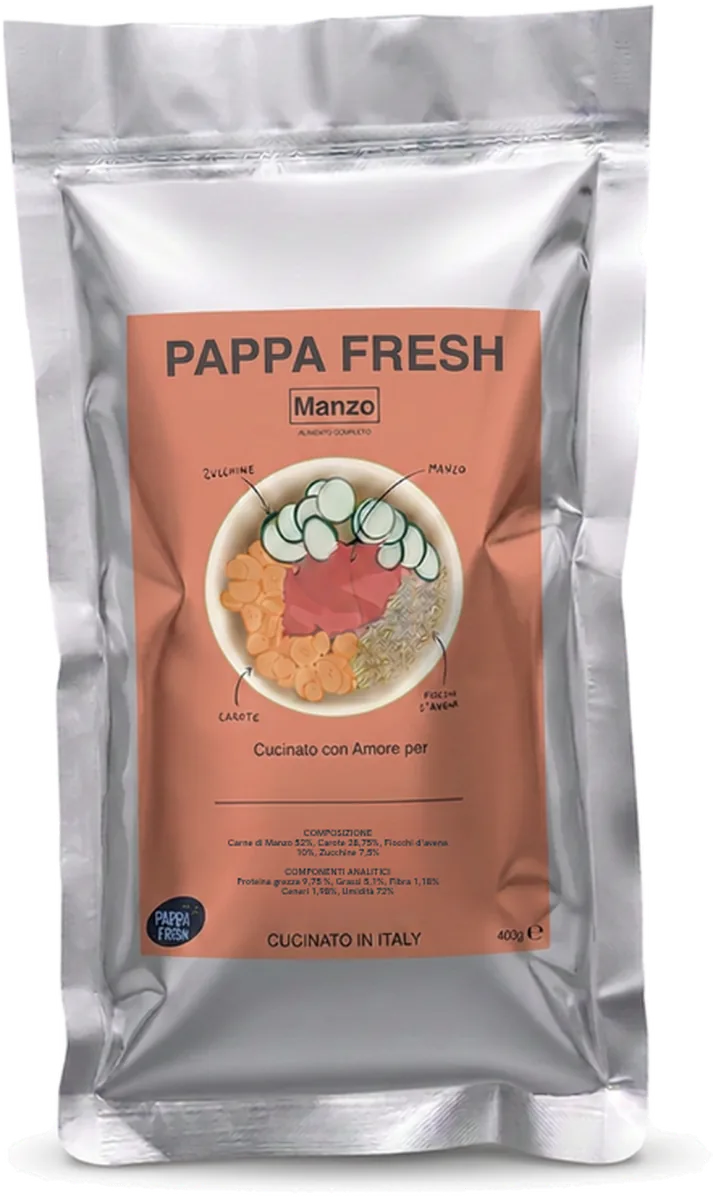
Our Beef recipe
Italian beef (52%) with carrots, oat flakes and zucchini, plus a vitamin and mineral supplement: a complete wet food. For dogs over 25 kg the quiz starts from the Topper, a quarter of the ration next to their usual food.
How can bloat in dogs be prevented?
With feeding habits, which are the part that depends on you. Studies have linked a higher risk to:
- a single meal a day and very large meals: better two or three meals;
- eating fast: a slow-feeder bowl or food scattered on a snuffle mat helps;
- a raised bowl, contrary to what people often say: on the floor is fine;
- vigorous exercise straight after a meal: after eating, only a calm walk;
- drinking large amounts of water all at once, for example after a run;
- stress, such as kennels or travel: if you can, keep its routine.
In very high-risk dogs, for example with a close relative that had bloat, the vet may suggest a preventive gastropexy, also by keyhole surgery; in young females it can be done during spaying.
Does the type of food matter for bloat?
Less than people think: the studies disagree, and how much and how the dog eats matter more.
- Kibble itself has not been found to be a risk factor in the more recent studies; in a European study, of the dogs affected 40% ate dry food, 26% wet food and 25% fresh meat.
- In an American study, dogs whose diet also included wet food or table food had a lower risk; in another, kibble with an oil or fat among the first four ingredients was linked to a 2.4 times higher risk, but the same research group had earlier found a different result.
- In Great Danes, very small kibble, under 5 mm, was linked to more bloat, and pieces larger than 3 cm to less: probably because they make the dog chew and eat more slowly.
In practice: choose a complete food your dog eats happily, split it into several meals and let it eat calmly.
Where Pappa Fresh fits in
Our recipes are a complete wet food: real meat as the first ingredient (52% to 67%), a single animal protein per recipe, vegetables and a vitamin and mineral supplement, steam-cooked and sterilised in the pouch.
For large dogs the quiz suggests the Topper, a quarter of the daily ration next to its usual food, or the Mix, half the ration. Whatever your dog eats, for the breeds most at risk the habits on this page matter most: more meals, eating calmly, no running straight after.
Two minutes, portions calculated for your dog, 30% off your first order.
Frequently asked questions
How long does a dog with bloat have?
A few hours: it is an emergency. If you see a swollen belly and retching without vomiting, go straight to an open vet clinic, even at night.
Does a raised bowl help prevent bloat?
No: in one study, large-breed dogs that ate from a raised bowl had a higher risk. If your dog has no particular problem, a bowl on the floor is fine.
Can my dog run after eating?
Better not: vigorous exercise straight after a meal is one of the risk factors. After eating a calm walk is fine; games and running later.
Can small dogs get bloat?
Rarely: it mostly affects large and giant dogs with a deep chest, but it can also happen in smaller dogs.
What is a gastropexy?
It is an operation that fixes the stomach to the abdominal wall so it cannot twist. It is done after bloat and, in very high-risk dogs, also to prevent it, sometimes during spaying.
Sources
- Hand et al., Small Animal Clinical Nutrition, 5th ed. (2010) — ch. 53, gastric dilatation and gastric dilatation-volvulus in dogs
- Glickman et al. 2000, Journal of the American Veterinary Medical Association — incidence and breed-related risk factors for GDV
- Glickman et al. 2000, Journal of the American Veterinary Medical Association — non-dietary risk factors in large and giant breeds (raised bowl, affected relatives)
- Glickman et al. 1997, Journal of the American Animal Hospital Association — multiple risk factors, a case-control study
- Raghavan et al. 2006, Journal of the American Animal Hospital Association — dry food ingredients and the risk of GDV
- Theyse et al. 1998, Veterinary Record — kibble size and age as risk factors in Great Danes
Pappa Fresh editorial team
Written by the Pappa Fresh editorial team from published veterinary studies (see sources). Not a substitute for your vet's advice.
Read next:
- Dog bad breath: where it comes from and what to do
- Dog gas and flatulence: why it happens and what to do
- Shiny dog coat: what really matters in the diet
- Dog diarrhoea: what to feed your dog and when to worry
- Foods dogs can't eat: what's toxic and what to do
- Dog won't eat dry food: why it happens and what to do
- Feeding an older dog: what changes and what to give
- Constipation in dogs: what to give and when to worry
- How Much Should a Dog Eat Per Day?