Feeding an older dog: what changes and what to give
Over the years a dog moves less, sometimes eats less, sometimes puts on weight. But many of the rules people repeat, like cutting protein, are not backed by studies. Here is what really changes and what to put in its bowl.
In short
A dog counts as senior at different ages depending on its size: around 11-12 years if it is small, 7-8 if it is a giant breed. It often needs fewer calories, because it moves less, but very old dogs tend to lose weight instead: its weight is the guide. Protein should not be cut in a healthy dog: with age it loses muscle and needs good-quality protein; it is reduced only when kidney disease has been diagnosed. Water at all times, a complete food that is easy to chew and a vet check at least once a year.
For the older dog: build the plan with Horse →
At what age is a dog a senior?
It depends on size: small dogs live longer and age later. According to a survey of vets reported in the clinical nutrition textbooks, a dog can be considered senior at roughly these ages:
| Size | Weight | Senior from about |
|---|---|---|
| Small | up to 9 kg | 11-12 years |
| Medium | 9-23 kg | 10 years |
| Large | 23-41 kg | 9 years |
| Giant | over 41 kg | 7-8 years |
These are guidelines: how the dog is doing matters more than its date of birth. In a study quoted in the textbooks, 38% of small dogs were still alive at 10 years, against 13% of large dogs.
Should an older dog eat less?
Often yes, but not always: its weight is the guide. With age many dogs move less and lose muscle, so they burn fewer calories and, if they eat as before, they put on weight. It doesn't happen to all of them: in Border Collies that kept working, energy needs did not fall with age. And very old dogs often tend to lose weight, and then they need a richer, tastier food.
Keeping it lean matters: in a study of 48 Labradors followed for their whole lives, the dogs fed 25% less, and kept lean, lived a median of 13 years against 11.2, and osteoarthritis came later.
In practice: weigh your dog once a month and check its shape (you should feel the ribs under your fingers without pressing). If it gains or loses weight, adjust the portion. In our quiz, age is one of the details we use to calculate the portion.
Do older dogs need less protein?
No, not if they are healthy. It is one of the most widespread beliefs, but the veterinary nutrition textbooks say the opposite: with age a dog loses muscle mass, and in one study older dogs needed up to 50% more protein than young dogs to maintain their reserves. There is no evidence that cutting protein helps a healthy older dog, and a high-protein diet has not been shown to cause kidney disease in healthy animals.
A dog's kidneys have a large reserve: up to 75% of kidney tissue can be lost before signs appear. That is why kidney disease should be looked for with blood and urine tests, not prevented by taking meat away from every dog.
A dog with diagnosed kidney disease is a different case: there phosphorus and, usually, protein are reduced, with a diet chosen by the vet.
What should I feed an older dog?
A complete food, with good-quality protein and the right amount of calories for its weight. In practice:
- Quality protein: real meat, easy to digest, so it doesn't lose muscle.
- Calories to measure: fewer if it tends to gain weight, more if it tends to lose it.
- Little salt: an older dog doesn't need it, and heart and kidney disease become more common with age.
- A little fibre if it tends to be constipated, which is more common with age.
- Food that is easy to chew if it has dental problems, the most common health problem in older dogs.
- Water available at all times.
For memory and orientation there are studies on DHA, an omega-3 from fish oil, and on MCT fats, but they are few and partly funded by pet food manufacturers: if your dog seems a little confused, ask your vet.
For a healthy older dog, a complete wet food made of real meat is a simple choice: soft to chew, full of aroma, easy to digest. Our recipes have meat as the first ingredient, 52% to 67%.
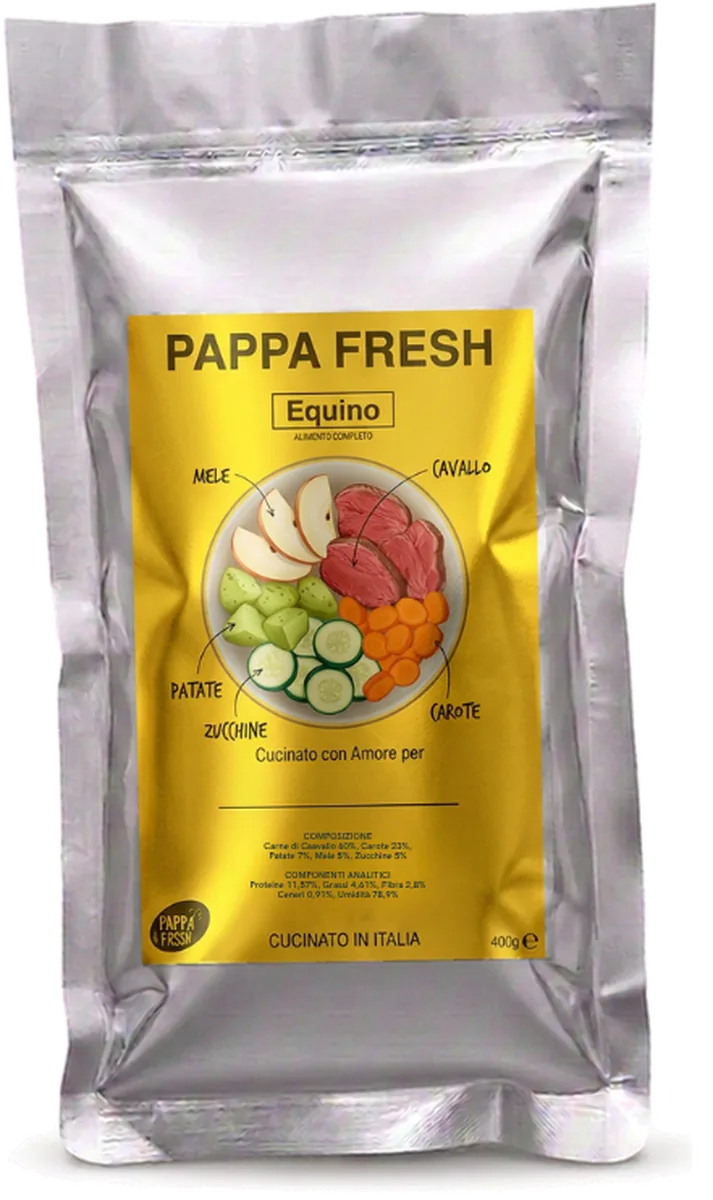
For the older dog
Our Horse recipe
Horse meat (60%) with carrots, potatoes, apple and zucchini, plus a vitamin and mineral supplement: a protein different from the usual ones and little fat, in a wet food that is soft to chew. No freezer needed: unopened pouches keep in the cupboard.
My older dog isn't eating: what should I do?
First of all, find out why. The most common causes in older dogs:
- Teeth: tartar, inflamed gums and broken teeth make chewing painful, especially kibble.
- Weaker smell and taste: with age food smells and tastes of less, and the dog feels less like eating.
- Pain: osteoarthritis can make even standing at the bowl hard work.
- Illness: kidneys, heart, liver, cancer.
- Change: losing a companion, a house move, a new person at home.
Soft, aromatic food at room temperature, smaller and more frequent meals and a bowl in a quiet, easy-to-reach spot all help. If it loses weight or eats less and less, take it to the vet. More tips in our guide to the dog that won't eat dry food.
How much water should an older dog drink?
It should always have water available, because with age it feels less thirsty and becomes dehydrated more easily. Medicines such as diuretics, and kidneys that concentrate urine less well, also raise the risk. Put several bowls around the house, change the water often and remember that wet food brings water too.
On the other hand, if it drinks much more than usual, it is not a good sign: it can be due to the kidneys, diabetes or other hormonal diseases, and should be checked. Read how to recognise and prevent dehydration.
Which illnesses change an older dog's diet?
The ones that become more common with age. In these cases the vet decides the diet:
- Kidney disease: a diet with less phosphorus and, usually, less protein.
- Heart disease: attention to salt and to appetite, which often drops (read our guide to heart disease in dogs).
- Osteoarthritis: the most useful thing is the right weight.
- Cognitive dysfunction: according to the textbooks, 28% of dogs aged 11-12 and 68% of those aged 15-16 showed signs of it.
- Dental disease: it needs cleaning by the vet and a food the dog can chew.
That is why the textbooks advise checking the kidneys and blood pressure regularly from 5 years of age: a blood and urine test once a year is the best investment in its health.
Which breeds age earliest?
Large and giant breeds: for them senior age comes as early as 7-9 years. The textbooks suggest reviewing the diet at around 5 years in large and giant breeds and at around 7 in small ones.
- Giant and very large breeds such as the St Bernard, Newfoundland and Cane Corso: they are seniors at 7-8 years, so it pays to keep them lean from a young age.
- Large breeds such as the Rottweiler, Doberman, German Shepherd, Labrador and Golden Retriever: seniors at around 9 years, and extra weight weighs on the joints.
- Small breeds such as the Chihuahua, Yorkshire Terrier, Poodle and Jack Russell: they age later, but have dental problems more often.
Where Pappa Fresh fits in
For a healthy older dog our recipes are a complete, soft wet food: real meat as the first ingredient (52% to 67%, with 10.6-12.9 g of protein per 100 g), a single animal protein per recipe, vegetables and a vitamin and mineral supplement, with no preservatives. They are designed to be easy to digest.
Horse and Turkey are the recipes with the least fat; Beef is the richest (136 kcal per 100 g). In the quiz you enter age, weight and body shape, and we calculate the portion.
If your dog has kidney or heart disease, follow your vet's diet: our recipes are not veterinary diets.
Two minutes, portions calculated for your dog, 30% off your first order.
Frequently asked questions
At what age does a dog become a senior?
It depends on size: around 11-12 years for small dogs, 10 for medium, 9 for large and 7-8 for giant breeds. How the dog is doing matters more than its age, though.
Does an older dog need senior dog food?
Not necessarily. What matters is that the food is complete, with good-quality protein, and that the portion is right for its weight and activity.
Is protein bad for an older dog's kidneys?
In a healthy dog this has not been shown. Protein and phosphorus are reduced when kidney disease has been diagnosed, on the vet's advice.
Can older dogs eat wet food?
Yes, as long as it is a complete food. It is often easier to chew for dogs with dental problems, and it brings water too.
How many times a day should an older dog eat?
Two meals suit most dogs. If it eats little or struggles to digest, three or four smaller meals can help.
Sources
- Fascetti, Delaney, Larsen, Villaverde (eds), Applied Veterinary Clinical Nutrition, 2nd ed. (2023) — ch. 7, senior dogs (age by size, energy, protein, senses, kidneys)
- Hand et al., Small Animal Clinical Nutrition, 5th ed. (2010) — ch. 14, the mature dog (protein and kidneys, salt, cognitive dysfunction, survival by size)
- Kealy et al. 2002, Journal of the American Veterinary Medical Association — diet restriction and life span in 48 Labradors
- Pan et al. 2010, British Journal of Nutrition — MCT fats and cognitive function in older dogs
- WSAVA — body condition score chart for dogs
Pappa Fresh editorial team
Written by the Pappa Fresh editorial team from published veterinary studies (see sources). Not a substitute for your vet's advice.
Read next:
- Dog bad breath: where it comes from and what to do
- Dog gas and flatulence: why it happens and what to do
- Shiny dog coat: what really matters in the diet
- Dog diarrhoea: what to feed your dog and when to worry
- Foods dogs can't eat: what's toxic and what to do
- Dog won't eat dry food: why it happens and what to do
- Bloat in dogs (GDV): signs, risks and what to do
- Constipation in dogs: what to give and when to worry
- How Much Should a Dog Eat Per Day?