Constipation in dogs: what to give and when to worry
Your dog squats, strains and nothing comes out, or just a few hard stools. It usually passes quickly with water, exercise and a few changes at mealtimes. Here are the causes, what to give, what to avoid and when you need the vet.
In short
A dog is constipated when it poos rarely and with difficulty, and the stools are small, dry and hard. The most common causes are too little water, bones or indigestible things it has eaten, too little exercise and pain when squatting. Start with water (wet food brings plenty too), then a little cooked pumpkin or a fibre such as psyllium, increased slowly, and more walks; no human laxatives without the vet. If it hasn't pooed for more than two days, strains in pain, vomits or is dull, take it to the vet.
No bones, with vegetables: build the plan with Beef →
How can I tell if my dog is constipated?
It poos less often than usual, with difficulty, and the stools are small, dry and hard. Other signs:
- it squats several times without result, or strains for a long time;
- it seems to be in pain while pushing, or afterwards;
- if it goes on: less appetite, vomiting, dullness, weight loss.
Watch out for two common mix-ups. A dog with colitis also strains a lot, but passes soft stools with mucus: that is not constipation. And a dog straining without result might be unable to pee: a urinary blockage is an emergency, especially in males. If you see neither stools nor urine coming out, call the vet straight away.
Why is my dog constipated?
Almost always because of something it ate, too little water or too little exercise. The most common causes according to the textbooks:
- Bones and indigestible things: bones, stones, soil, sticks. Raw diets with a lot of bone are among the described causes of severe constipation in dogs.
- Too little water: if the dog is dehydrated, the gut takes back more water from the stools, which become hard.
- Too little exercise, especially in older or overweight dogs.
- Pain when squatting: osteoarthritis, hip problems, inflamed anal glands, a hernia near the anus or an old pelvic fracture.
- Medicines: some painkillers, anti-epileptic drugs and stomach products can slow the gut down.
What can I give a constipated dog?
Water first, then a little fibre and more exercise.
- Water: several bowls around the house, fresh water at all times, a little unsalted broth without onion to make it more appealing. The textbooks also advise choosing wet food over dry, because it brings plenty of water with it.
- Pumpkin: a little cooked pumpkin, with no salt or sugar, in the bowl. It is mostly water and contains fibre: that is probably why it works.
- Fibre, slowly: for example psyllium, increased gradually; ask your vet for the right dose for its weight.
- Exercise: more frequent walks help the gut to move.
- Regular meals, small and frequent if it struggles.
Avoid: laxatives and enemas for people, liquid paraffin given by mouth (dangerous if it goes down the wrong way) and bones. According to the textbooks, adding fibre to the diet is better than laxatives alone.
Which fibre does a constipated dog need?
Not all fibres are the same, and too much fibre all at once can make things worse.
- Fibres that hold water, such as psyllium, make stools softer and are among the most used.
- Fibres that only add dry bulk, such as pure cellulose, are the worst choice for an already constipated gut according to the most recent textbooks.
- Highly fermentable fibres can cause wind, cramps and diarrhoea if increased quickly.
The rule is to increase a little at a time and watch the stools. In dogs whose gut barely moves, as in megacolon, too much fibre does more harm than good: there the vet decides the diet.
Can bones make a dog constipated?
Yes, they are one of the most common causes. Bones, raw or cooked, leave hard fragments and bone dust in the stools that form a compact plug, hard to pass and sometimes painful. Cooked bones also splinter and can injure or block the gut.
If your dog is constipated after eating bones and isn't better within a day, or is in pain, talk to your vet. All the foods to avoid are in our guide to foods dogs can't eat.
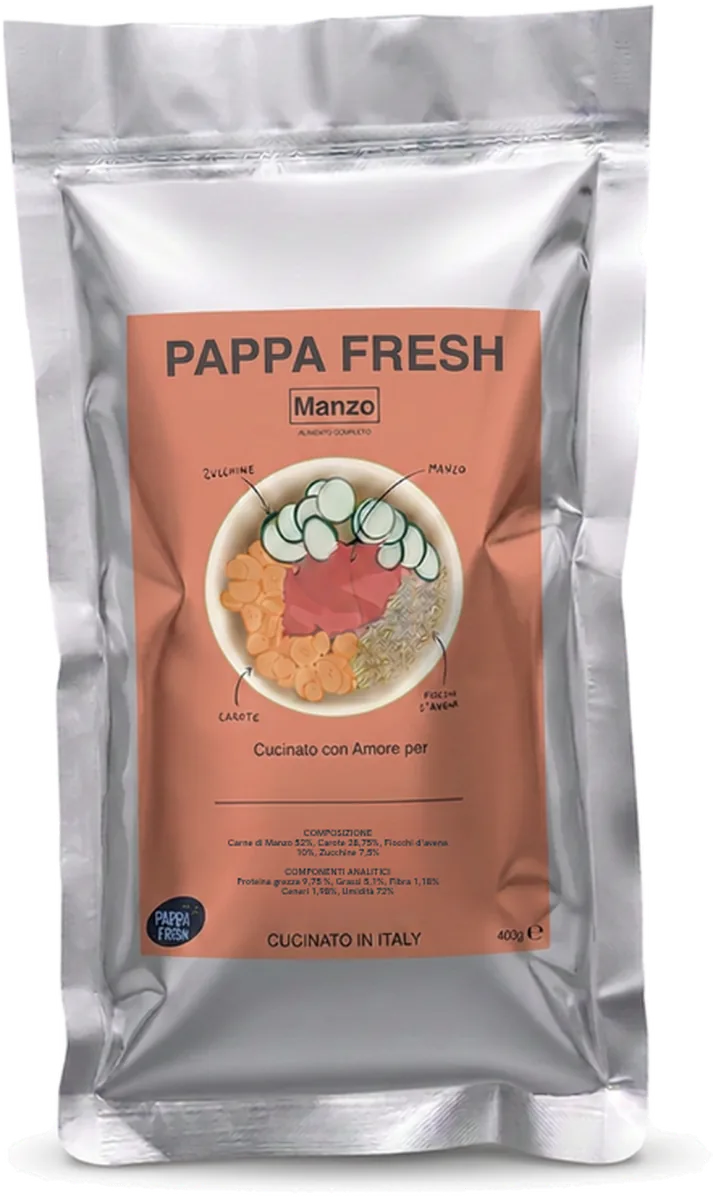
No bones, with vegetables
Our Beef recipe
Italian beef (52%) with carrots (28.6%), oat flakes (10%) and zucchini, plus a vitamin and mineral supplement: a complete wet food, with no bones. No freezer needed: unopened pouches keep in the cupboard.
When should a constipated dog see the vet?
Straight away if it can pass neither stools nor urine; otherwise if it isn't better within a couple of days. Call the vet:
- if it hasn't pooed for more than two days, or strains for a long time without result;
- if it is in pain, vomits, won't eat or is dull;
- if there is blood in the stools;
- if it has eaten bones, a toy or another object;
- if constipation keeps coming back: then tests (blood, urine, thyroid hormones, X-rays) are needed to find the cause.
The vet may need to empty the bowel with an enema or, in the most stubborn cases, under sedation: don't try it yourself.
Which dogs are constipated most often?
Older dogs, dogs that eat bones and dogs that are in pain when they go.
- Older dogs: constipation becomes more common with age, along with less exercise and less thirst (read our guide to feeding an older dog).
- German Shepherd: the breed most affected by perianal fistulas, chronic wounds around the anus that make going to the toilet painful.
- Dogs with osteoarthritis or hip problems, which struggle to squat.
- Dogs fed a lot of bones or used to chewing objects.
Where Pappa Fresh fits in
Our recipes are a complete wet food, with no bones: real meat as the first ingredient (52% to 67%), vegetables and a vitamin and mineral supplement, steam-cooked and sterilised in the pouch. Beef is the recipe with the most vegetables (carrots 28.6%) and with oat flakes; Horse has carrots, potatoes, apple and zucchini.
If your dog is often constipated, have your vet find the cause first. If you then switch to Pappa Fresh, do it over 7-10 days, mixing the new food into the old, and always leave water available.
Two minutes, portions calculated for your dog, 30% off your first order.
Frequently asked questions
How many days without pooing before I should worry?
If your dog hasn't pooed for more than two days, or sooner if it strains in pain, vomits, won't eat or is dull, call the vet. If it can't pee either, it is an emergency.
How much pumpkin should I give a constipated dog?
Start small, for example a teaspoon for small dogs and a tablespoon for large ones, cooked, with no salt or sugar, mixed into its food. If it isn't better after a day or two, talk to your vet.
Can I give oil to a constipated dog?
Better not without your vet: liquid paraffin given by mouth can cause pneumonia if it goes down the wrong way. Water, pumpkin, fibre and exercise are safer.
Is wet or dry food better for a constipated dog?
Nutrition textbooks advise choosing wet food, because it brings plenty of water, together with fibre and exercise. More than the type of food, though, what matters is finding the cause.
Can constipation make a dog vomit?
If it goes on, yes: vomiting, poor appetite and dullness can appear. In that case, or if you see blood in the stools, take your dog to the vet.
Sources
- Hand et al., Small Animal Clinical Nutrition, 5th ed. (2010) — ch. 64, constipation and megacolon (causes, water, pumpkin, fibre)
- Fascetti, Delaney, Larsen, Villaverde (eds), Applied Veterinary Clinical Nutrition, 2nd ed. (2023) — ch. 11, constipation and choice of fibre
- Merck Veterinary Manual — Constipation, Obstipation, and Megacolon in Small Animals
- Merck Veterinary Manual — Perianal Fistula in Dogs (German Shepherd)
- Merck Veterinary Manual — Urethral Obstruction in Small Animals (urinary blockage)
Pappa Fresh editorial team
Written by the Pappa Fresh editorial team from published veterinary studies (see sources). Not a substitute for your vet's advice.
Read next:
- Dog bad breath: where it comes from and what to do
- Dog gas and flatulence: why it happens and what to do
- Shiny dog coat: what really matters in the diet
- Dog diarrhoea: what to feed your dog and when to worry
- Foods dogs can't eat: what's toxic and what to do
- Dog won't eat dry food: why it happens and what to do
- Feeding an older dog: what changes and what to give
- Bloat in dogs (GDV): signs, risks and what to do
- How to prevent dehydration in dogs