What is the best dog food?
Not a brand, but six things you can check on the label and in the way the food is made. Here is how to choose your dog's food, whether it is kibble, wet food or fresh food.
In short
The best dog food is a complete food with a named meat as the first ingredient, suited to your dog's age and fed in the right amount. Kibble, wet food and fresh food can all be good: they differ in water, processing, storage and price. For a dog with a medical condition, the vet decides.
If you choose fresh: create your dog's plan →
What is the best dog food?
There is no single best brand for every dog: the best food is a complete one, made with ingredients you can recognise, suited to your dog's age, that your dog eats happily and that keeps them in shape. Brand rankings help little, because the same food can suit one dog perfectly and another badly.
To choose, check six things:
- "Complete" on the label, not "complementary": only a complete food is enough on its own as the daily meal.
- A named meat as the first ingredient ("beef", "chicken"), ideally with its percentage.
- A clear composition: specific names rather than broad categories such as "meat and animal derivatives".
- The right life stage: growth for a puppy, maintenance for an adult.
- Who formulates the recipes: a nutritionist or a vet trained in nutrition, with analyses of the finished product. These are the questions the vets' guidelines (WSAVA) suggest asking the manufacturer.
- How your dog does in the weeks after the switch: steady weight, formed stools, normal energy and appetite.
How can you tell from the label if a dog food is good?
From the ingredient list, which is in order of weight: what you read first is what there is most of. Then from how the ingredients are named:
- if the maker uses categories ("meat and animal derivatives", "cereals", "derivatives of vegetable origin"), you do not know which animal is in it or how much meat;
- if the pack highlights an ingredient, in words or pictures, it has to state its percentage;
- the product name matters: under the European pet food industry's labelling code (FEDIAF), "beef flavour" means less than 4% beef, "with beef" at least 4%, "rich in beef" at least 14% and "beef dinner" or "beef menu" at least 26%;
- words like "premium", "holistic" or "gourmet" have no rules behind them: the WSAVA guidelines say they tell you little about quality.
Next, the analytical constituents: protein, fat, fibre and ash, plus moisture when it is above 14%. To compare a dry food with a wet one you have to take the water out: a wet food with 10% protein and 75% moisture has 40% protein on a dry-matter basis, more than a kibble that declares 26% with 10% moisture (29%).
There is a step-by-step example in our guide on how to read dog food labels.
What does "complete" mean on a dog food label, and why does it matter?
It means the food on its own covers everything your dog needs every day: that is the definition in the European feed regulation (EC 767/2009). A "complementary" food is only enough when combined with something else: treats and toppers are complementary, and so are some tins. It is written on the label.
To be complete, a food has to meet the minimum levels, and for some nutrients the maximum levels too, of the FEDIAF nutritional guidelines, which differ for growth and for maintenance. The WSAVA guidelines suggest feeding complementary foods only as a small part of the diet, 10% or less.
This is the weak spot of home-made food: a University of California study of 200 home-made dog food recipes, taken from books and websites, found that 95% fell short on at least one essential nutrient, and more than 83% on several (Stockman et al. 2013). If you want to cook for your dog, you need a recipe written by a veterinary nutritionist; if you would rather have a fresh food that is already complete, the 5 Pappa Fresh recipes are formulated by a veterinary nutritionist.
Is kibble, wet food or fresh food better?
All three can be good food if they are complete: they differ in water, processing, storage and price.
| Kibble | Wet | Fresh | |
|---|---|---|---|
| Water | 14% or less | 60% or more | 60% or more |
| Processing | extruded at high heat, then dried | cooked and sterilised in the tin | cooked and portioned, then frozen, chilled or sterilised in a pouch |
| Storage | cupboard | cupboard; once opened, fridge | freezer, fridge or cupboard, by type |
| Strengths | price, convenience | water, taste | clear ingredients, water, taste |
| Limits | little water; quality varies a lot | quality varies a lot | price; frozen and chilled need space |
What the studies say: in two University of Illinois trials, on 8 and on 12 dogs, cooked fresh foods were more digestible than kibble; in the second, dogs on kibble produced 1.5 to 2.9 times more faeces (Algya et al. 2018; Do et al. 2021). On a wet food with 71% water, dogs took in 141% of their minimum water needs in total, against 102% on kibble (Sires et al. 2025). These are small studies on chilled foods, and two of the three were carried out with companies that make fresh food. None of them measures lifespan.
What is the best fresh dog food?
The same rules apply, plus three questions about the format: does it store the way you need, are the portions worked out for your dog, and does the maker say who writes the recipes. "Fresh dog food" is not a legal category: it is the name for recipes made with meat and vegetables rather than meals, cooked and portioned.
- Is it complete? Some fresh foods are complementary: check the label.
- How is it stored? Frozen food keeps for months, but it needs freezer space and has to be thawed in the fridge before each meal. Chilled food goes in the fridge and keeps for less time. Food sterilised in its pouch stays in the cupboard while sealed; once opened, it goes in the fridge.
- Are the portions worked out for your dog? With fresh food the amount matters even more: for the same calories it weighs about three times as much as kibble, and it is easy to get wrong by eye. Our guide on how much a dog should eat explains how to work it out.
- Does the maker tell you who formulates the recipes, how many calories they have per 100 g and how to get in touch? This is the information the WSAVA guidelines say you should expect.
The Pappa Fresh recipes tick all three: they keep for 2 years in the cupboard, the portions in the plan are worked out for your dog, they are formulated by a veterinary nutritionist and each recipe page gives the composition and the calories per 100 g.
If the freezer is the problem, here is how fresh dog food without a freezer works.
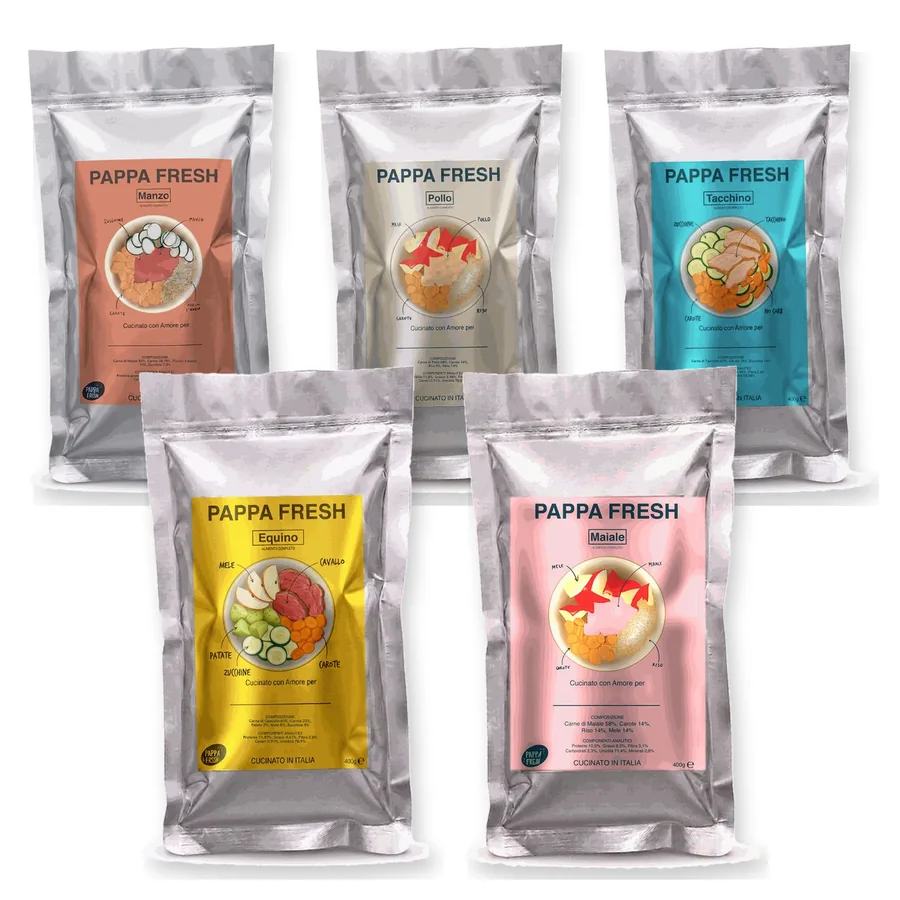
If you choose fresh
Fresh dog food. No freezer.
One meat per recipe plus real vegetables, cooked in their pouch: they keep for 2 years in the cupboard. Portions in the plan are worked out from your dog's weight, age and activity.
What is the best food for a puppy, an older dog or a small dog?
- Puppy: a complete food "for growth" or "for all life stages". In large-breed puppies calcium and calories matter too: growing too fast is bad for the bones, so stick to the amount and check the weight. More in our puppy feeding guide.
- Older dog: there is no fixed age. According to FEDIAF, large dogs count as "senior" from 5-8 years, small ones from around 10. Most need fewer calories, but not all: weight and vet check-ups are what count. If your dog eats little, a tastier food and the right texture, dry or wet, help. See our guide on feeding an older dog.
- Small dog: for every kilo of body weight a small dog uses more energy than a large one, so portions are small but have to be worked out carefully; with kibble the size of the pieces matters too.
- Dog with a medical condition: the choice is your vet's. For kidney or liver disease, diagnosed allergies and other conditions there are dietetic foods, regulated by a separate EU regulation (EU 2020/354).
How much does good dog food cost?
It depends on the format and on your dog's weight: compare the cost per day, not the price per kilo. A kilo of kibble has about 3,500-4,000 kcal, a kilo of wet or fresh food about 1,000-1,400, because it is at least two thirds water: for the same calories you need about three times as much, so the price per kilo on its own is misleading.
A high price guarantees nothing, because you also pay for the brand and the packaging, and a very low one rarely buys good meat. The simplest method: choose first with the criteria in this guide, then compare the cost per day for your dog among the foods that meet them. More on this in why cheap dog food can cost more. You can see what Pappa Fresh costs per day for your dog in two minutes by building the plan.
How does Pappa Fresh measure up to these criteria?
- Complete food, in 5 recipes with a single animal protein each: beef, chicken, turkey, horse and pork.
- Meat is the first ingredient, from 52% to 67%, and the composition lists every percentage: no preservatives, colourings or meat meal.
- Recipes formulated by a veterinary nutritionist, with the calories per 100 g measured by an accredited laboratory and printed on each recipe page.
- Cooked and sterilised in the sealed pouch: it keeps for 2 years in the cupboard, with no fridge or freezer; once opened, the pouch goes in the fridge and is used within 2-3 days.
- Portions worked out for your dog: weight, age, activity and neutering.
The pages of the 5 recipes, with composition and calories, are here.
Two minutes, portions calculated for your dog, 20% off your first order.
Frequently asked questions
What is the best dog food brand?
There is no single one for every dog. Choose a complete food with a named meat as the first ingredient, suited to your dog's age, from a maker that tells you who formulates the recipes. Then watch how your dog does over the following weeks: weight, stools, energy and appetite.
Is the most expensive dog food the best?
No. The price also pays for the brand and the packaging. Compare the cost per day for your dog among complete foods with clear ingredients: wet or fresh food costs more per kilo partly because it is at least two thirds water.
Is fresh food better than kibble?
In studies, cooked fresh foods were more digestible and gave dogs more water; kibble costs less and is more convenient. Neither is best for every dog: what matters is that the food is complete and that your dog does well on it.
Can fresh dog food be kept out of the fridge?
It depends on the type: frozen food goes in the freezer and chilled food in the fridge; food sterilised in a sealed pouch stays in the cupboard until its use-by date. Once opened, any wet or fresh food goes in the fridge and is used within a few days.
Can I make my dog's food at home?
Yes, but with a recipe written by a veterinary nutritionist. In a study of 200 home-made recipes taken from books and websites, 95% fell short on at least one essential nutrient.
How do I know if my dog's food is right?
Your dog's weight stays steady and you can feel the ribs without seeing them, stools are formed, and your dog has energy and eats happily. If something changes, talk to your vet before changing food.
Sources
- WSAVA Global Nutrition Committee, Guidelines on Selecting Pet Foods (2021)
- FEDIAF, Code of Good Labelling Practice for Pet Food (2019) — composition, "with", "rich in", "menu"
- FEDIAF, Nutritional Guidelines for Complete and Complementary Pet Food for Cats and Dogs (2025)
- FEDIAF Scientific Advisory Board, Nutrition of senior dogs (2017)
- Regulation (EC) No 767/2009 on the placing on the market and use of feed
- Stockman et al. 2013, J Am Vet Med Assoc — 200 home-made dog food recipes
- Algya et al. 2018, J Anim Sci — kibble, lightly cooked and raw diets compared
- Do et al. 2021, J Anim Sci — digestibility of fresh foods and kibble
- Sires et al. 2025, Frontiers in Veterinary Science — water intake on fresh food and kibble
Pappa Fresh editorial team
Written by the Pappa Fresh editorial team from published veterinary studies (see sources). Not a substitute for your vet's advice.
Read next:
- Dog bad breath: where it comes from and what to do
- Dog gas and flatulence: why it happens and what to do
- Shiny dog coat: what really matters in the diet
- Dog diarrhoea: what to feed your dog and when to worry
- Foods dogs can't eat: what's toxic and what to do
- Dog won't eat dry food: why it happens and what to do
- Feeding an older dog: what changes and what to give
- Bloat in dogs (GDV): signs, risks and what to do
- Constipation in dogs: what to give and when to worry
- Pancreatitis in dogs: signs, diet and what to feed
- Kidney disease in dogs: signs, diet and what to know
- How to Read Dog Food Labels: a Vet's 4 Secrets