Pancreatitis in dogs: signs, diet and what to feed
It often follows a big blow-out: a dog that vomits, has a sore belly and won't eat. Pancreatitis can be mild or severe, and diet matters both during the episode and afterwards. Here is what to know, what to feed and which foods to avoid.
In short
Pancreatitis is inflammation of the pancreas: the most common signs are vomiting and belly pain, then dullness, poor appetite, fever and diarrhoea. Risk factors include very fatty meals, table scraps and excess weight. During the episode the vet decides, but dogs are no longer kept without food for days: feeding restarts early with small, low-fat, highly digestible meals. If pancreatitis comes back or becomes chronic, the diet needs to stay low in fat, meaning less than 20% of the calories coming from fat, and no fatty scraps.
Our leanest recipe: build the plan with Pork →
What is pancreatitis in dogs?
It is inflammation of the pancreas, the organ that makes digestive enzymes and insulin. The enzymes switch on too early and damage the pancreas itself and the organs around it.
- Acute: it comes on suddenly; it can be mild or very severe and need hospital care.
- Chronic: milder episodes that keep coming back, sometimes without obvious signs, which over time can damage the pancreas permanently.
The vet makes the diagnosis, usually with a pancreas-specific blood test and an ultrasound scan.
What are the signs of pancreatitis in dogs?
The most common are vomiting and belly pain. Often there is also:
- dullness: the dog withdraws or doesn't want to move;
- little or no appetite;
- fever;
- diarrhoea;
- in the chronic form: eating less, losing weight, bouts of belly pain that come and go.
Repeated vomiting together with a sore belly is a reason to see the vet the same day, especially if your dog has just eaten something very fatty.
What causes pancreatitis in dogs?
The exact cause is often never found, but some factors raise the risk.
- Very fatty meals and scraps: in one study, eating unusual food, table scraps or rubbish was linked to a higher risk. It is the classic pancreatitis after Christmas or a barbecue.
- Excess weight: in one study 43% of dogs with acute pancreatitis were overweight or obese, and in another being overweight raised the risk of a fatal form.
- Too much fat in the blood (hyperlipidaemia), more common in some breeds.
- Other illnesses such as diabetes, hypothyroidism, Cushing's disease and epilepsy, and some anti-epileptic drugs.
What should I feed a dog with pancreatitis?
During the episode the vet decides; afterwards, it depends on how many times it has happened.
- During: for years dogs were kept without food for 24-48 hours or for as long as they vomited. Today clinical nutrition textbooks advise restarting early, as soon as the vomiting is under control, with small meals of a low-fat, highly digestible food: in studies, dogs fed early had fewer digestive problems and went back to eating on their own sooner.
- After a single episode with a clear cause, such as a blow-out: your dog can gradually go back, over a few days, to its usual complete food, avoiding the cause.
- If it comes back or is chronic, or if the dog has too much fat in its blood: the diet needs to stay low in fat for good.
How low in fat? According to the textbooks, for dogs eating commercial food a diet with less than 20% of its calories from fat counts as "low fat"; another practical rule is to halve the fat compared with the previous diet. Watch the protein too: very high amounts should be avoided.
To work it out from a label: multiply the grams of fat per 100 g by 8.5 and divide by the calories per 100 g. For example, 2.4 g of fat in a food with 112 kcal gives 2.4 × 8.5 ÷ 112 = 18% of calories from fat.
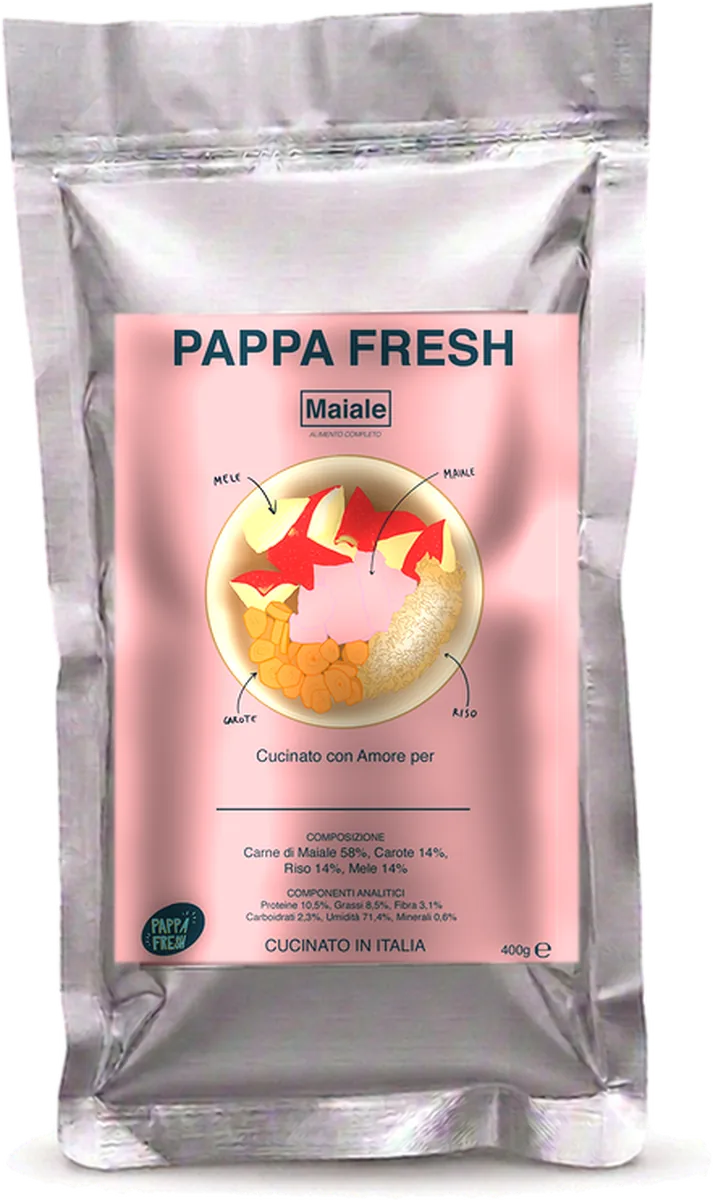
Our leanest recipe
Our Pork recipe
Pork (58%) with carrots, rice and apple, plus a vitamin and mineral supplement: 2.4 g of fat per 100 g, 18% of calories (lab analysis). It is not a veterinary diet: ask your vet whether it is right for your dog.
Which foods should a dog with pancreatitis avoid?
Anything very fatty, even in small amounts.
- cold meats, sausages, crackling, chicken skin, meat fat;
- fatty cheese, butter, cream;
- fried food, leftover gravy and roast trimmings, sweets;
- very fatty treats and chews.
Read labels carefully: according to the textbooks some foods sold as "light" or "reduced fat" are still too fatty for a dog with pancreatitis, and the wet and dry versions of the same product can be very different. If an episode was triggered by a particular food, stay well below its fat content from now on. The other dangerous foods are in our guide to foods dogs can't eat.
Should a dog with pancreatitis lose weight?
If it is overweight, yes: extra weight is one of the factors linked to pancreatitis. The right plan is gradual weight loss on a low-fat diet, agreed with your vet, until your dog is back to its ideal shape: you should feel the ribs under your fingers without pressing.
No drastic do-it-yourself diets: a dog that stops eating altogether does not lose weight healthily. More on fats and excess weight in our article on fats and overweight dogs.
Which breeds are prone to pancreatitis?
Some breeds more than others, especially those prone to too much fat in the blood.
- Yorkshire Terrier: in an American study of dogs that died of acute pancreatitis it was among the breeds at highest risk.
- Miniature Schnauzer and Shetland Sheepdog: prone to hyperlipidaemia, one of the risk factors.
- Labrador and Miniature Poodle: in the same study they had a lower than average risk.
Sex and history matter too: in that study males and neutered females were at higher risk, as were overweight dogs and dogs with other illnesses such as diabetes or previous gut problems.
Where Pappa Fresh fits in
Our Pork recipe has 2.4 g of fat per 100 g: according to the lab analyses of our recipes it is the leanest, with 18% of its calories coming from fat. It is a complete food, with real meat as the first ingredient, carrots, rice and apple, steam-cooked and sterilised in the pouch.
It is not a veterinary diet. If your dog has had an episode, ask your vet whether it could be right for your dog once it is eating normally again. Our other recipes contain more fat, from 30% to 56% of their calories.
Two minutes, portions calculated for your dog, 30% off your first order.
Frequently asked questions
Should a dog with pancreatitis be starved?
Not for days. During the episode the vet decides, but today feeding restarts early, as soon as the vomiting is under control, with small, low-fat, highly digestible meals.
Can a dog recover from pancreatitis?
Many dogs with a mild acute form recover well. Severe forms can be dangerous, and chronic forms are managed long term with a low-fat diet and vet check-ups.
Is chicken and rice good for pancreatitis?
Boiled skinless chicken breast and rice, with no seasoning, are low in fat and are often used for a few days. They are not a complete diet: for the long term your dog needs a complete low-fat food chosen with your vet.
How much fat should food for a dog with pancreatitis contain?
According to the textbooks, a food with less than 20% of its calories from fat counts as low fat; another rule is to halve the fat compared with the previous diet. Your vet will tell you the right level for your dog.
Can pancreatitis come back?
Yes, especially if the dog keeps eating fatty foods or stays overweight. That is why, after an episode, the right diet and no fatty scraps matter.
Sources
- Fascetti, Delaney, Larsen, Villaverde (eds), Applied Veterinary Clinical Nutrition, 2nd ed. (2023) — ch. 12, pancreatitis (signs, risk factors, early feeding, low-fat diets)
- Hand et al., Small Animal Clinical Nutrition, 5th ed. (2010) — ch. 67, pancreatitis
- Hess et al. 1999, Journal of the American Veterinary Medical Association — risk factors for fatal acute pancreatitis in dogs
- Harris et al. 2017, Journal of Veterinary Emergency and Critical Care — early enteral nutrition in 34 dogs with pancreatitis
Pappa Fresh editorial team
Written by the Pappa Fresh editorial team from published veterinary studies (see sources). Not a substitute for your vet's advice.
Read next:
- Dog bad breath: where it comes from and what to do
- Dog gas and flatulence: why it happens and what to do
- Shiny dog coat: what really matters in the diet
- Dog diarrhoea: what to feed your dog and when to worry
- Foods dogs can't eat: what's toxic and what to do
- Dog won't eat dry food: why it happens and what to do
- Feeding an older dog: what changes and what to give
- Bloat in dogs (GDV): signs, risks and what to do
- Constipation in dogs: what to give and when to worry
- Kidney disease in dogs: signs, diet and what to know
- Is Fat Bad for Dogs? Good Fats, Fats to Avoid and Excess Weight